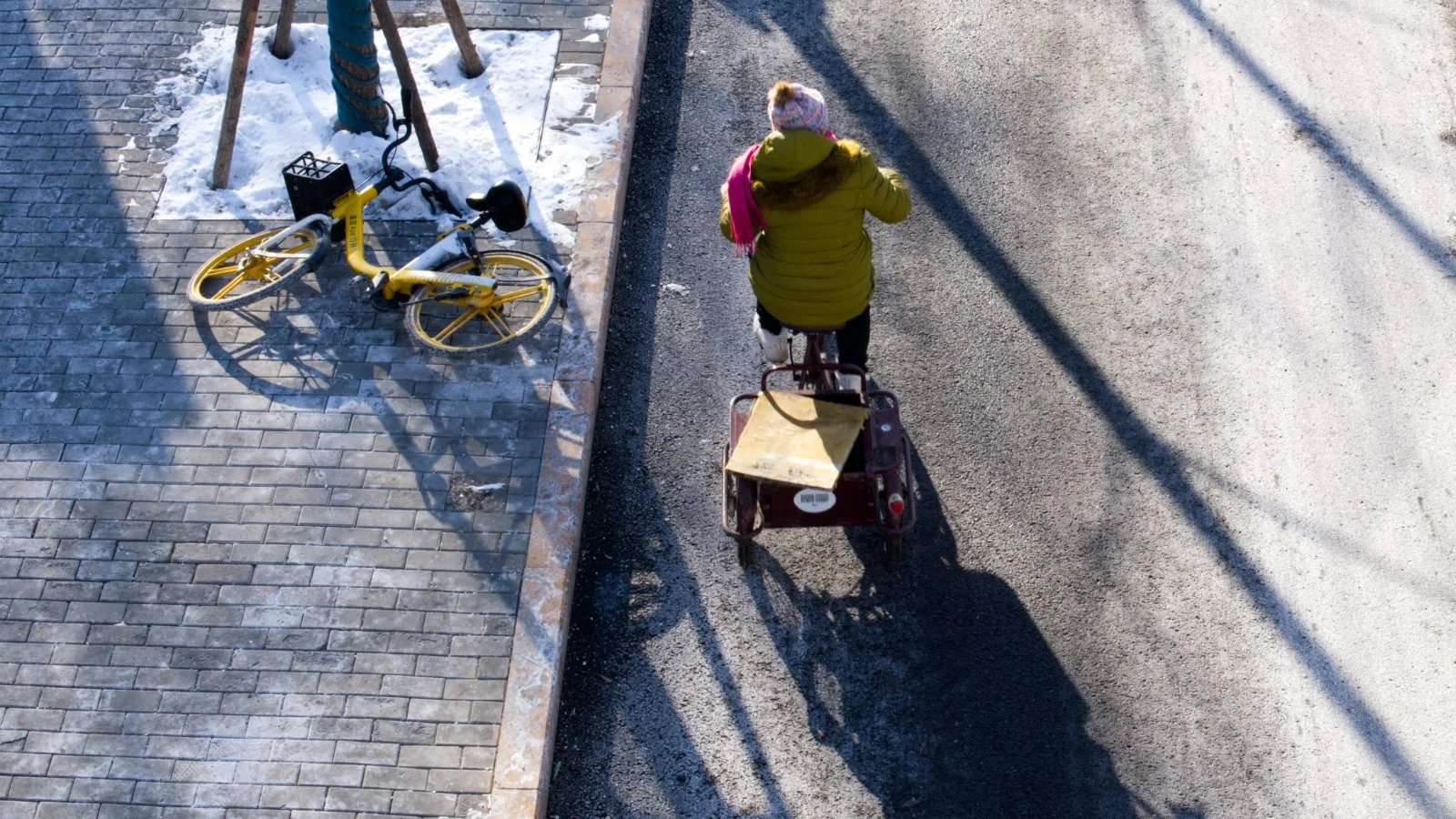
My relationship with Beijing has been shaped by return. I have travelled to China on a number of occasions, primarily to visit family, but each trip has also become an opportunity to observe, photograph, and quietly study the city as it moves around me. What began as instinctive image-making has gradually developed into a deeper photographic inquiry—one rooted in people, place, and the experience of witnessing change over time.
Beijing is a city that resists stillness. It operates at speed, in constant motion, and on a scale that can feel overwhelming. From the moment you step into its streets, you are surrounded by density: of people, of architecture, of histories layered on top of one another. As a photographer, this fastness has always drawn me in. I find myself watching how people move through space, how bodies navigate crowds, how moments of intimacy exist alongside vast urban backdrops.
With each visit, my way of seeing has shifted. Early trips were about reacting—responding to the unfamiliar, to the intensity of the environment, to the visual overload. Over time, something quieter began to emerge. I started noticing patterns: recurring gestures, similar spatial relationships, a shared visual language forming across different locations and moments. These weren’t isolated to Beijing alone. The same sensibility began to appear across my photographic work more broadly, suggesting the development of a style or series that I hadn’t consciously set out to create.
What interests me most is the tension between permanence and transformation. Beijing is a city in continual development. Returning after months or years away, familiar streets can feel altered, buildings replaced, neighbourhoods reshaped. Yet at the same time, certain rhythms remain—the daily routines, the presence of family, the repetition of ordinary life. Photographing within this context has made me more attentive to subtle shifts rather than dramatic change: how light falls differently, how public spaces are re-used, how faces carry both time and continuity.
Family plays an essential role in this work. Travelling to Beijing is never just about the city; it is also about personal history, connection, and belonging. Photographing family alongside public life allows these images to sit between the personal and the documentary. They are not intended to explain or define Beijing, but rather to reflect my own lived experience within it—fragmented, ongoing, and deeply subjective.
The photographs I am sharing from Beijing represent a work in progress. This body of work is still under development, and I see it as an open archive rather than a finished statement. Each return adds another layer, another set of observations, another opportunity to refine my focus. What matters to me is not capturing a definitive version of the city, but allowing the work to grow alongside my understanding of it.
My long-term goal with this project is to develop a more focused and intentional approach: to document people, places, faces, family, and everyday life in a way that builds a collective and cohesive body of work. I want these images to speak to one another across time, revealing connections that only become visible through repetition and return.
Beijing continues to challenge and shape my photographic practice. It asks me to slow down within a fast city, to look closely at what might otherwise be overlooked, and to trust that meaning can emerge gradually. This work is not about arrival, but about the act of coming back—and what it means to keep looking.